- Published on
'Sovereignty Without Swords': The Strategic Genius of Demilitarization
- Authors

- Name
- livingtheparadox.net
Introduction: The Paradox of Sovereign Demilitarization
The Westphalian model of the nation-state is traditionally predicated on the monopoly of violence—the capacity of a sovereign entity to project force internally to maintain order and externally to deter aggression. Within this paradigm, the standing army is not merely a tool of statecraft but a constitutive element of statehood itself.
Yet, a distinct and often overlooked subset of the international community defies this convention. Comprising over thirty sovereign nations, these states operate without a standing military, challenging the realist assumption that hard power is the sine qua non of survival in an anarchic international system.
It is not sufficient to merely list them; one must understand the mechanisms of their survival. How does a state like Costa Rica exist in a volatile region without a single tank? How does Iceland secure the critical GIUK gap in the North Atlantic without a navy? The answer lies in a complex architecture of "defense by proxy," constitutional pacifism, and collective security arrangements that substitute diplomatic capital for military hardware.
Our analysis reveals three primary archetypes of demilitarization:
- The Constitutional Abolitionists: Predominantly in Latin America, these states dismantled their militaries to inoculate the state against internal coups.
- The Strategic Protectorates: European microstates and Pacific island nations whose defense is contractually outsourced to a benevolent hegemon.
- The Collective Security Adherents: States that pool paramilitary resources to create a regional security umbrella.
Furthermore, we witness the rise of "camouflaged armies"—units like Panama's SENAFRONT or Mauritius's Special Mobile Force—that possess military-grade weaponry while legally remaining civilian bodies.
Part I: The Latin American Model – Constitutional Pacifism
The most radical form of demilitarization occurs when a state with a history of martial conflict voluntarily dismantles its armed forces. This phenomenon, centered in Latin America, represents a deliberate rejection of the "garrison state" model that plagued the region throughout the 20th century.
1.1 The Republic of Costa Rica: The Archetype of Unarmed Democracy
Costa Rica serves as the foundational case study for voluntary demilitarization, providing empirical evidence for the "butter over guns" hypothesis—that redirecting defense expenditure to human capital can yield superior developmental outcomes.
The Historical Pivot (1948) To understand Costa Rica's present, one must dissect the trauma of 1948. The country was engulfed in a violent civil war triggered by a contested presidential election, claiming over 2,000 lives—a catastrophic loss for a small nation. The victorious rebel commander, José Figueres Ferrer, found himself at a crossroads. Possessing the power to install a junta, he instead performed an act of unprecedented political theater.
On December 1, 1948, Figueres took a sledgehammer to the Bellavista Barracks, symbolically breaking the military's stranglehold on the state. He disbanded the army for two reasons:
- Coup Prevention: He recognized that in the Cold War Caribbean Basin, a standing army was a liability that tempted ambitious officers to overthrow civilian rule.
- Resource Reallocation: Abolishing the military freed up fiscal resources, allowing Figueres to hand the keys of the barracks to the Minister of Education [1].
The Constitutional Lock The abolition is codified in Article 12 of the 1949 Constitution: "The Army as a permanent institution is abolished... Military forces may only be organized under a continental agreement or for the national defense" [1]. This nuance is critical; it abolishes the permanent institution but reserves the sovereign right to mobilize for self-preservation.
Defense Architecture (TIAR) Costa Rica relies on the Inter-American Treaty of Reciprocal Assistance (Rio Treaty) of 1947, which stipulates that an attack on one is an attack on all [2].
- The 1955 Invasion: When forces invaded from Nicaragua, the OAS invoked the Rio Treaty, and the US sold four P-51 Mustang fighters to Costa Rica for $1 each to repel the invaders.
- Proclamation of Neutrality (1983): During the Contra War, President Monge issued a proclamation of "Perpetual, Active, and Unarmed Neutrality" to insulate the country from US proxy wars, while explicitly maintaining rights under the Rio Treaty.
The "Paramilitary Paradox" While legally demilitarized, Costa Rica maintains the Special Intervention Unit (UEI) within its Public Force. They receive training from US Special Forces and use military-grade small arms. Their operational doctrine in border regions mirrors light infantry, reflecting the necessity of "military-lite" capabilities against drug cartels.
1.2 The Republic of Panama: Demilitarization by Intervention
If Costa Rica's demilitarization was a birth of idealism, Panama's was a rebirth from trauma following the US invasion (Operation Just Cause) in 1989 that dismantled the Panamanian Defense Forces (PDF) and deposed General Noriega [3].
Constitutional Amendment (1994) To prevent the return of a caudillo, Article 310 was ratified, stating unequivocally: "The Republic of Panama shall not have an army". Like Costa Rica, it allows for temporary special police units during aggression but bans the permanent institution.
The Canal Defense Dilemma Under the Neutrality Treaty (1977), the United States retains the permanent right to defend the Panama Canal's neutrality. This effectively makes the US the guarantor of Panama's external security, a dependency paid as the price for the Canal's transfer [4].
SENAFRONT: The Army in All But Name? To secure the Darién Gap against Colombian insurgents and traffickers, Panama created the National Border Service (SENAFRONT). Operating in battalions with military ranks and automatic rifles, SENAFRONT functions as a jungle warfare force. This highlights the fluidity of "demilitarization": the political institution is gone, but the kinetic capability remains.
Part II: The European Microstates – Sovereignty Under the Shield
These states exist as sovereign anomalies, preserved by the balance of power between larger neighbors who eventually formalized protection obligations.
2.1 Principality of Andorra
Andorra survived as a feudal co-principality between France and Spain.
- Treaty of Good Neighbourliness (1993): Following its democratic constitution, this treaty modernized defense. France and Spain respect Andorra's sovereignty, and the "Co-Princes" (French President and Bishop of Urgell) retain powers to approve international defense treaties [5].
- Internal Security: Defense historically relied on the Sometent (ceremonial militia of household heads), but today relies on the Police Corps.
2.2 Principality of Liechtenstein
Liechtenstein abolished its army in 1868 because the cost of maintaining 80 men was unsustainable.
- The Swiss Relationship: Since the 1923 Customs Treaty, Liechtenstein has been integrated into the Swiss economic zone.
- The Defense Myth: Contrary to popular belief, no formal defense treaty exists. In 2025, the Swiss Federal Council explicitly stated they would not automatically defend Liechtenstein to preserve Swiss neutrality. However, the Principality enjoys "protection by proximity"—any ground invasion would necessitate violating Swiss territory.
2.3 Principality of Monaco
- Treaty Evolution: The 1918 treaty threatened Monaco's sovereignty if the Grimaldi line failed. The 2002 Friendship and Cooperation Treaty removed this clause and explicitly stated: "The French Republic ensures the defense of the independence and sovereignty of the Principality" [6].
- The Prince’s Carabiniers: A 120-man unit responsible for palace security, professionally trained but ultimately a guard force rather than an army.
2.4 Vatican City State
- Pontifical Swiss Guard: Often dismissed as a tourist attraction, they are the military force of the Holy See. Recruited exclusively from Swiss citizens with army training, they are equipped with modern Sig Sauer weaponry and trained in counter-terrorism.
- The Italian Guarantee: Under the Lateran Treaty (1929), Italy polices St. Peter's Square and acts as the external buffer against conventional threats [7].
Part III: The Pacific Strategy – Strategic Denial
Small island states utilize "strategic denial": granting exclusive military access to a hegemon in exchange for total protection.
3.1 The Compacts of Free Association (COFA)
Palau, Micronesia, Marshall Islands operate under Compacts with the United States.
- The Deal: The US is obligated to defend these nations "as the United States and its citizens are defended" [8].
- Strategic Denial: In return, the US can deny military access to any third nation (e.g., China) in these territories. This locks a massive corridor of the Pacific into the US defense sphere.
- Nuclear Legacies: The agreements strictly regulate the storage of nuclear weapons, a sensitive issue given the history of testing in the Marshall Islands.
3.2 Samoa
Samoa relies on the 1962 Treaty of Friendship with New Zealand.
- Diplomatic Proxy: New Zealand is obligated to "consider sympathetically" requests for assistance and acts as a channel for Samoa's foreign relations.
- Operational Reality: The Royal New Zealand Navy provides maritime security and fisheries patrol.
3.3 Tuvalu: The Falepili Union
In 2023, Tuvalu signed a landmark union with Australia.
- The Guarantee: Australia commits to assist in "military aggression," natural disasters, and pandemics [9].
- The Sovereignty Veto: Article 4 requires Tuvalu to "mutually agree" with Australia before entering security pacts with other states, effectively granting Australia a veto to preclude Chinese influence.
- Climate Security: Uniquely, the treaty frames climate change as a security threat, creating migration pathways for Tuvaluans.
3.4 Nauru and Kiribati
These nations are the battleground for influence. Nauru signed a security treaty with Australia in 2024 to integrate its security. Meanwhile, Kiribati has pivoted toward China, with Chinese officers engaging in "community policing," illustrating the vulnerability of demilitarized states to "police cooperation" as a wedge for foreign influence.
Part IV: The Caribbean Security System (RSS)
Eastern Caribbean states rejected national armies after the 1983 Grenada invasion (Operation Urgent Fury) and a coup attempt in Dominica. They concluded that small armies were threats to democracy.
The RSS Treaty (1996) Barbados, Antigua and Barbuda, Dominica, St. Kitts and Nevis, St. Lucia, St. Vincent and the Grenadines, and Grenada formed the Regional Security System.
- Article 4: Contains a collective defense clause mirroring NATO's Article 5: "an armed attack against one of them... is an armed attack against them all" [10].
- Hybrid Force: In a crisis, the RSS mobilizes Special Service Units (SSUs) and Coast Guards from member states into a single Regional Task Force, creating a standing army on demand without the permanent cost.
Part V: The Strategic Outliers
5.1 Iceland: The North Atlantic Anomaly
Iceland is the only NATO member without a standing army.
- 1951 Defense Agreement: The US guarantees Iceland's defense [11]. While the permanent base closed in 2006, the US has returned to Keflavík on a "rotational" basis with P-8 Poseidon aircraft to monitor the GIUK gap against Russian submarines.
- Coast Guard: A civilian force with military responsibilities, famous for winning the "Cod Wars" against the Royal Navy using cable-cutting tactics.
5.2 Mauritius
- Chagos Deal (2024): In a historic deal, the UK transferred sovereignty of the Chagos Islands to Mauritius but retained the Diego Garcia military base for 99 years [12]. This effectively outsources Mauritius's ultimate security to the Anglo-American alliance.
5.3 Vanuatu
Vanuatu maintains the Vanuatu Mobile Force (VMF). While legally police, they are a paramilitary body. The risk of this model was exposed in 1996 when VMF members briefly abducted the President over a pay dispute, proving that "demilitarized" forces still possess praetorian risks.
Conclusion: The Future of the Unarmed State
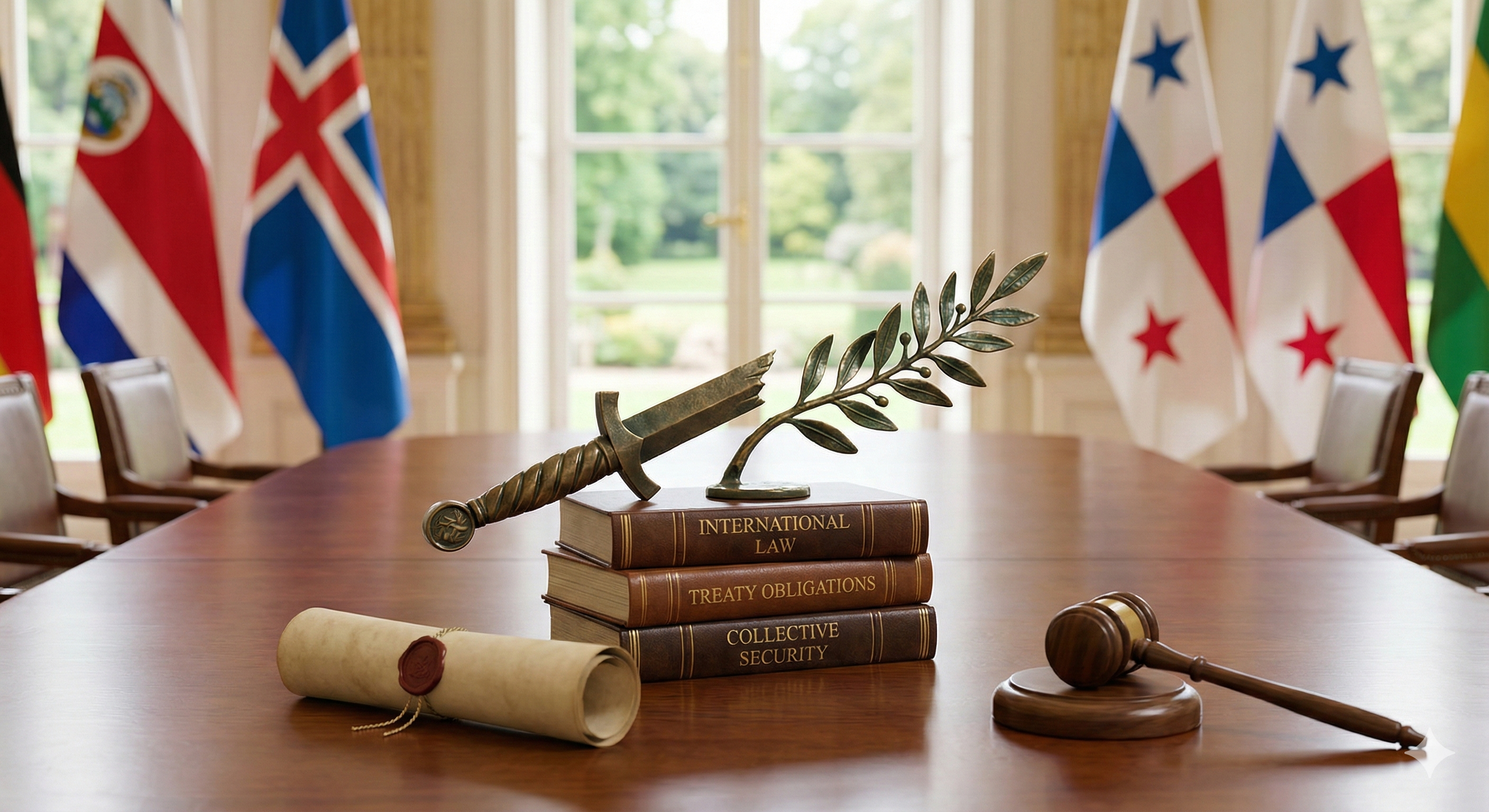
The existence of over thirty nations without standing armies is a testament to the evolution of international order. These states have successfully substituted the "sword" of national defense with the "shield" of international law and collective security.
However, the "pure" demilitarized state is rare. Most maintain paramilitary forces—like Panama's SENAFRONT or Costa Rica's UEI—that blur the line between police and soldiers to confront modern threats. Furthermore, the return of Great Power competition is stressing these arrangements. Treaties like the Falepili Union represent a new generation of pacts where sovereignty is explicitly traded for protection against existential threats—both military and climatic.
While these nations do not march standing armies, they are far from undefended. They have constructed a sophisticated architecture of treaties and alliances that allows them to navigate the anarchic international system, proving that sovereignty does not require a standing army, provided one has the diplomatic acumen to borrow someone else's.
Comparative Data of Defense Architectures
| State | Army Status | Primary Legal Defense | Guarantor | Paramilitary Force |
|---|---|---|---|---|
| Costa Rica | Abolished (1949) | Rio Treaty (TIAR) | USA / OAS | Public Force (UEI) |
| Panama | Abolished (1994) | Neutrality Treaty | USA | SENAFRONT |
| Iceland | Never Established | 1951 Defense Agreement | USA / NATO | Coast Guard |
| Liechtenstein | Abolished (1868) | Customs Treaty (Implied) | Switzerland | National Police |
| Monaco | Never Established | Friendship Treaty (2002) | France | Carabiniers |
| Tuvalu | Never Established | Falepili Union (2023) | Australia | Police |
| Dominica | Disbanded (1981) | RSS Treaty (1996) | RSS System | SSU |
| Mauritius | Never Established | Chagos Agreement (2024) | UK / USA | SMF |
References
- [1] Article 12, Constitution of Costa Rica (1949). Political Constitution of the Republic of Costa Rica. Link to source
- [2] Inter-American Treaty of Reciprocal Assistance (Rio Treaty). Organization of American States (OAS). Link to treaty text
- [3] The Legality of the United States Invasion of Panama. CORE. Link to analysis
- [4] Treaty Concerning the Permanent Neutrality and Operation of the Panama Canal (1977). Panama Canal Authority. Link to treaty PDF
- [5] Treaty of Good Neighbourliness, Friendship and Cooperation (1993). United Nations Treaty Series. Link to record
- [6] Franco-Monégasque Treaty of 2002. European Parliament. Link to Mutual Defense Clause context
- [7] Lateran Treaty (1929). EBSCO / Wikipedia. Link to summary
- [8] Compacts of Free Association (COFA). US Congress. Link to CRS Report
- [9] Australia-Tuvalu Falepili Union Treaty. Australian Dept of Foreign Affairs and Trade (DFAT). Link to treaty PDF
- [10] Regional Security System (RSS) Treaty. Regional Security System. Link to context
- [11] Defense of Iceland: Agreement of 1951. US Department of State. Link to document
- [12] The Change in Sovereignty for the Chagos Archipelago (2024). IISS Strategic Comments. Link to analysis
Enjoyed this deep dive? Leave a comment below.
Keep reading
Related posts
Dec 9, 2025
0Comments'No Brown M&Ms': Van Halen's Genius Quality Control Hack
An analysis of rock and roll's most famous contract demand, revealing it not as diva behavior, but as a brilliant, low-cost heuristic for systemic safety compliance.
Dec 8, 2025
0Comments'Everybody Has a Plan Until They Get Punched in the Mouth': The Failure of Static Strategy
Mike Tyson's famous quote isn't just about boxing; it's a lesson in strategy. We break down why plans fail in the face of chaos and how to build resilient systems.
Dec 19, 2024
0CommentsDo You Know Who Said 'Keep Your Friends Close, But Your Enemies Closer'?
This post explains the meaning and origin of the proverb 'Keep your friends close, but your enemies closer.
Disclaimer: comments are the responsibility of their authors and are managed on GraphComment.
